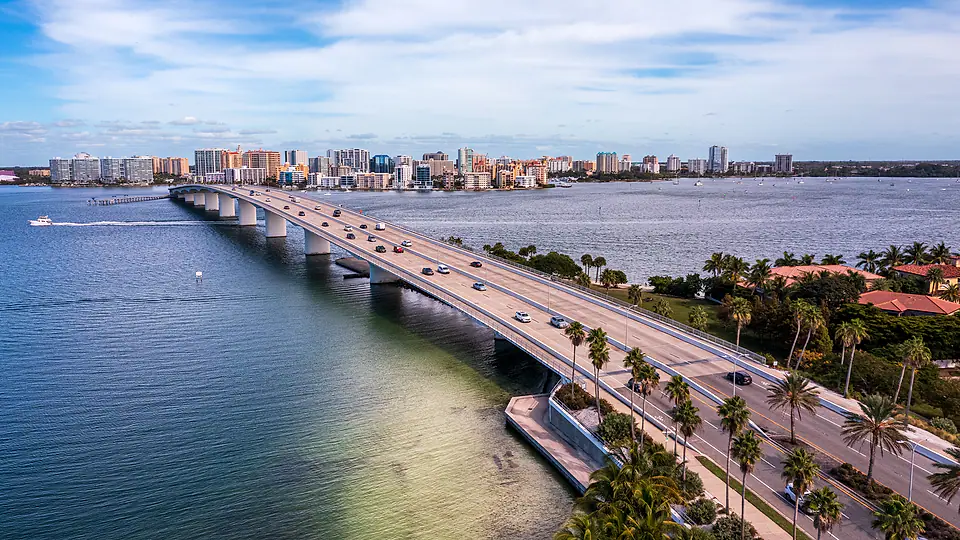
Where Sarasota Property Cases Are Filed
Venue is not a formality; it decides which judges, which local rules, and which jury pool your case answers to. Sarasota County sits in the Twelfth Judicial Circuit alongside Manatee and DeSoto counties. Florida circuit courts hear civil actions above $50,000 (where most contested property claims land once repair costs and coverage are in dispute) and county courts hear actions at or below that figure, including small claims of $8,000 or less. Circuit civil matters for Sarasota County are handled at the Silvertooth Judicial Center (also called the North County Courthouse) on Ringling Boulevard downtown.
A first-party insurance suit is a breach-of-contract action, and where it is filed turns on the policy, the amount in dispute, and the parties. Local counsel matters here for reasons that are concrete rather than sentimental: familiarity with the Twelfth Circuit’s civil division practices, with the local adjusters and defense firms who appear on these files repeatedly, and with what a Sarasota jury understands about barrier-island construction and Gulf-front risk. We handle venue, pre-suit notice, and filing as part of every representation, so you are not guessing which courthouse your claim belongs in.
The Storms Behind Sarasota’s Property Claims
Three recent storms drive most of the property damage litigation in this market, and their legal deadlines run differently because Florida rewrote its claim statutes in December 2022.
Hurricane Milton (October 9, 2024). Milton made landfall near Siesta Key as a Category 3 storm with roughly 120 mph winds, driving surge from Venice south and wind damage across the county. Because Milton struck after the 2022 reforms, its claims run on the current schedule under Fla. Stat. § 627.70132: one year to report a new claim (that window closed October 9, 2025), eighteen months to file a supplemental claim (closed around April 9, 2026), and five years to file suit, to October 9, 2029. If your Milton claim was already reported, the door to litigate the underpayment or denial is still open; our hurricane damage practice covers those wind and surge disputes end to end.
Hurricane Helene (late September 2024). Helene did not make a Sarasota landfall, but its surge put at least six feet of Gulf water across Siesta Key and the barrier islands, and most of the serious damage there was structural, caused by water intrusion. Helene claims run on the same one-year, eighteen-month, and five-year structure from their own date of loss. Helene also created the classic coastal seam: a wind carrier blaming rising water and a flood carrier blaming wind. Sorting which peril did which damage (and which policy pays) is often the whole case.
Hurricane Ian (September 2022). Ian’s worst effects in Sarasota County were inland and to the south: extraordinary rainfall in Venice and North Port, wind across the county, and the largest storm response in the county’s history. Ian predates the December 2022 reforms, so the older notice and supplemental windows applied and have both closed; the five-year deadline to sue on an already-reported Ian claim runs to September 28, 2027.
You can run your own storm dates through our insurance claim deadline calculator, and if your carrier has simply gone quiet, our insurer response timeline checker shows which statutory response deadlines it has already missed. Every option below sits behind one of those dates.
Barrier Islands, Waterfront, and the Wind-Versus-Water Fight
Sarasota’s most valuable (and most exposed) property sits on the water. Siesta Key, most of it unincorporated, along with Lido Key, St. Armands, Bird Key, the Sarasota side of Longboat Key, and the southern keys through Casey Key, Nokomis, and Osprey, all took wind and surge in 2024. Waterfront claims here concentrate the hardest coverage questions: whether damage came from wind (generally covered by a homeowners policy) or from rising water (excluded from a homeowners policy and covered, if at all, under separate flood insurance); how the hurricane deductible applies; and whether a roof, seawall, dock, or pool enclosure is a repair or a replacement.
These are construction questions before they are legal ones, and that is the ground Cory Cannon is built on. I am a Florida attorney with a family history in the construction trades going back generations, and that upbringing shapes how I read a file. I read the carrier’s estimate, engineer report, and repair scope line by line, against how these buildings are actually assembled, and I check the carrier’s numbers against what licensed Sarasota-area contractors actually charge to do the work. When the insurer’s retained engineer calls creased shingles “mechanical damage” rather than wind, I know which measurements and photographs test that opinion, and we retain our own independent licensed engineers when a case needs a competing sworn opinion. If any part of your loss involves the insurer, start with our property insurance claims practice.
Aging Coastal Condos: Where Inspections, Insurance, and Defects Collide
Sarasota’s beachfront and downtown condominium stock is aging, and Florida’s post-Surfside safety regime now forces those buildings to look hard at their own structure. Under the milestone-inspection law (Senate Bill 4-D, as amended through House Bill 913 in 2025), condominium and cooperative buildings three habitable stories or higher must undergo milestone structural inspections at defined ages, and associations must fund a Structural Integrity Reserve Study for the building’s major structural components. In Sarasota, those inspections keep surfacing the same conditions storms already exposed: corroded rebar, spalled concrete, failed waterproofing, water-damaged balconies and railings.
For an association board, the question is which body of law pays for the repair. If a covered storm caused or worsened the damage, it is a first-party insurance claim, often a large master-policy claim measured against the association’s own deductible and the seam with unit-owner policies. That work runs through our condo and HOA insurance claim practice. If the damage traces to how the building was constructed or repaired (defective waterproofing, structural work that was never right), the responsible party may be a builder, developer, or contractor rather than any insurer, and the claim follows a different statute with its own pre-suit notice and deadlines; see our condo and HOA construction defect practice. Often both are in play at once, and pursuing them in the right order is the point. Boards should also know that funding major structural repairs and the associated special assessments generally requires a member vote, not a board decision alone.
New Construction From Lakewood Ranch to Wellen Park
Sarasota County is one of the busiest new-home markets in the country. Lakewood Ranch straddles the Sarasota-Manatee line east of I-75; Palmer Ranch fills south Sarasota; and Wellen Park anchors the North Port end of the corridor. That volume, built fast, produces the predictable defects of new construction: water intrusion at windows and doors, roofing and stucco problems, foundation and slab issues, and mechanical systems that were never commissioned correctly.
When a new Sarasota home fails, the defendant is usually the builder or a subcontractor, not your insurer, and Florida’s construction-defect statute (Chapter 558) requires a written notice and a chance to cure before suit. Our construction defects practice handles owner-side claims against builders and developers, and our construction litigation practice handles the contract, payment, lien, and delay disputes that arise on Sarasota projects. One local wrinkle worth confirming early: jurisdiction. The City of Sarasota, the City of Venice, North Port, and Longboat Key run their own building departments, while Siesta Key and much of the mainland are unincorporated and permitted through the Sarasota County Building Division. Which office holds the permit history and inspection records (county or city) can matter to a defect or code claim, and we track that down at the start of a case rather than the end.
Businesses and Contractors on the Suncoast
The same construction economy that fills Sarasota’s subdivisions runs on contracts, and when those break, the dispute is commercial rather than storm-driven. We represent Sarasota-area businesses (contractors, suppliers, developers, and the companies that serve them) in breach-of-contract claims, commercial lease disputes, partnership and shareholder fights, non-compete enforcement, and unfair-competition matters. Those cases carry their own deadlines and fee rules, and many are governed by contract or by statutes that shift attorney’s fees to the prevailing party. Our business and contract litigation practice covers that work, with a natural focus on the construction-adjacent disputes we understand best.
Start With Your Deadline
Whatever your Sarasota property problem (a denied Siesta Key wind claim, an underpaid Milton roof, a condo board staring at a milestone report, a new home in Wellen Park that leaks), the first move is the same. Find your date of loss, gather the policy and the carrier’s letters, and check the clock with our deadline calculator. Then request a free consultation. I will tell you plainly whether you have a claim worth pursuing, which body of law governs it, and what the statute requires next. The consultation costs nothing, and you owe nothing to find out where you stand.